
Author: IFTAA

Tax Incentive Policy for Geothermal Development: A Comparative Analysis in ASEAN

Penulis

Mohammad Zainul Abidin, Haula Rosdiana, Roy Valiant Salomo

Abstrak

This paper examines tax incentive policies in geothermal industries in ASEAN to better understand the development of geothermal industry investment in the ASEAN Member States (AMS) using a qualitative method. The results indicate that tax incentive policies have supported the investment climate and the development of geothermal industries in the AMS. Geothermal investments and production capacities in AMS have increased significantly. AMS that provide geothermal tax incentives include Indonesia, Lao PDR, the Philippines, Thailand and Vietnam. The performance of geothermal tax incentive policies is reflected in the level of utilization of geothermal potential, which is higher in states that provide greater tax incentives. The results also indicate that geothermal power plants in AMS use dry steam, flash and binary cycle technologies with flash plants being the most common. Results suggest that the future development of geothermal energy in AMS will be related to the tax incentive policy and investment climate in those states. Furthermore, the granting of various types of tax incentives should be focused on the initial investment in geothermal development.

Artikel

PDF

Sitasi

Abidin, Mohammad Zainul; Rosdiana, Haula; Salomo, Roy Valiant, “Tax Incentive Policy for Geothermal Development: A Comparative Analysis in ASEAN”, P International Journal of Renewable Energy Development . Feb2020, Vol. 9 Issue 1, p53-62. 10p.

Evaluation of Fiscal Policy on Agropolitan Development to Raise Sustainable Food Security (A Study Case in Bangli Regency, Kuningan Regency and Batu Municipality, Indonesia)

Penulis

Haula Rosdiana;

Inayanti;

Murwendah

Abstrak

This research examined the stagnant and even declining condition of the agropolitan program was implemented in Indonesia since 2002. Its progress was obstructed due to the national leadership restructuration. Worse of all, there is no Ministry to coordinate the implementation of this program, and minimal support from fiscal policies. The results of this research revealed how the fiscal policy implemented for the acceleration of agropolitan development has not been formulated in a comprehensive, integrative, and holistic manner yet. The current funding mechanism consists of different fiscal policies in each Regency/ City. This includes the different sources of funding, various agencies, and support from the community depending on the area. These differences also affect the success of the implementation of the agropolitan program in each area. In order to allow fiscal policy to accelerate the development of agropolitan areas, the Agropolitan Program Working Group must be more effective in coordinating the funding for the agropolitan program. The National Development Planning Agency must act as a coordinator so the agropolitan program will not overlap with other policies, or even become unnoticed. The the Master Plan for the Acceleration and Expansion of Economic Development (MPAEED) program should be integrated with agropolitan program due to their many similarities. By integrating these two programs, the objective of opening more employment opportunities, increasing the people’s profit thus improving their welfare, and improving agricultural sustainability, can be reached. Also, the coordination and integration of these programs will result in a more effective and efficient funding system.

Kata kunci

Agropolitan development; Fiscal policy; Growth center instrument; Tax incentives; Tax policy

Artikel

PDF

Sitasi

Haula Rosdiana, Inayati, Murwendah, Evaluation of Fiscal Policy on Agropolitan Development to Raise Sustainable Food Security (A Study Case in Bangli Regency, Kuningan Regency and Batu Municipality, Indonesia), Procedia Environmental Sciences, Volume 20, 2014,
Pages 563-572, ISSN 1878-0296, https://doi.org/10.1016/j.proenv.2014.03.069.

Indonesia Tax Authority Measure on Facing the Challenge in Taxing Digital Economy

Penulis

Maria R.U.D. Tambunan*, Haula Rosdiana

Abstrak

This article is intended to examine the challenges of taxing digital economy due to rapid development of technology in Indonesia. Those changes should be responded equally from the government perspective pertaining to the changes in tax regulation, structure/institutional of tax organization, human resources who understand the pattern and development of digital business and have capability to formulate tax regulation suitable for the business pattern, and information technology reliable in transforming the business of the tax organization. This study occupies constructivism paradigm and qualitiative research method. The data was gathered through literature review, documentation study and interview with informant. The research showed that for all of those aspects, the Indonesian government has realized that the change is very crucial. The government of Indonesia also fully realizes that the rapid development of the economic activities and should respond it by publishing various proper regulations and initiatives. However, some of the regulations are still insufficient to respond to the existing challenges. This indicates that in reality, the government is still unable to respond to the current dynamic properly and proportionally. Organization changing on the context of bureaucracy reform also still on the progress, similarly on the development of human resources capacity and the use of technology to optimize tax collection effort. Therefore, more comprehensive improvement through engagement of various agents to properly respond to the current economic development is essentially required.

Kata kunci

Taxation; Digital Economy; E-commerce

Artikel

PDF

Sitasi

Tambunan R.U.D Maria, Rosdiana Haula (2020), “Indonesia Tax Authority Measure on Facing the Challenge in Taxing Digital Economy”, Atlantic Press, Vol. 9 Issue 1, pp. 1-10. https://doi.org/10.2991/itmr.k.200203.001 

Reconstructing Accountability of The Cash Waqf (Endowment) Institution in Indonesia

Penulis

Dodik Siswantoro;

Haula Rosdiana;

Heri Fathurahman

Abstrak

Purpose

The purpose of this paper is to reconstruct the accountability of the cash waqf institution in Indonesia, including the logic which may refer to the accountability objective.

Design/methodology/approach

The paper employs the qualitative method with a constructivist paradigm. Four different characteristics of cash waqf institutions in Indonesia serve as the object of this research with other related respondents, such as the government and Islamic banks. These multiple case studies may represent the characteristics of cash waqf institutions.

Findings

The result shows that the cash waqf institution in Indonesia has unique and different logical characteristics, which is neither unitary nor pluralist.

Originality/value

This may be the first research which discusses the accountability-based logic for cash waqf institutions in Indonesia. These institutions apply Islamic teaching (Shariah) and must generate big income for social activities. Conditions in other countries may be similar since as waqf institutions have common concepts in general.

Kata kunci

Cash, Accountability, Waqf, Pluralist, Unitary

Artikel

PDF

Sitasi

Siswantoro, D.Rosdiana, H. and Fathurahman, H. (2018), “Reconstructing accountability of the cash waqf (endowment) institution in Indonesia”, Managerial Finance, Vol. 44 No. 5, pp. 624-644. https://doi.org/10.1108/MF-05-2017-0188

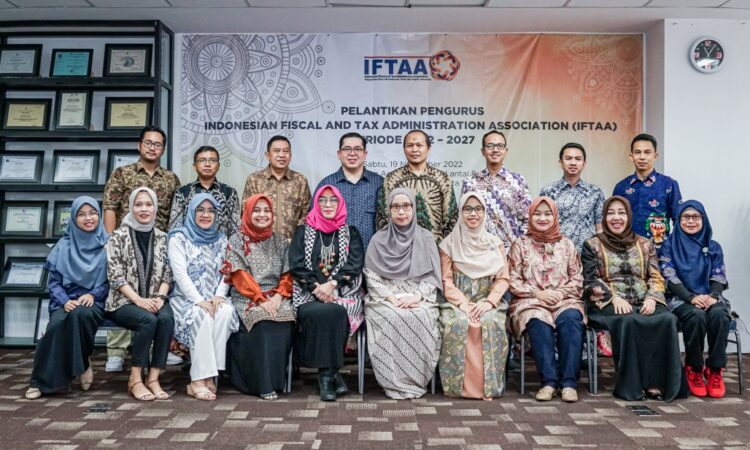
Lantik Pengurus Baru, IFTAA Berkomitmen Memajukan SDM Perpajakan Indonesia

Indonesian Fiscal and Tax Administration Association (IFTAA) telah melantik pengurus baru untuk periode 2022-2027.

Kegiatan pelantikan ini berlangsung pada tanggal 19 November 2022 di Gedung Antam Tower B, Jalan T.B. Simatupang No.1, Jakarta Selatan.

Pelantikan ini merupakan hasil dari Musyawarah Luar Biasa (Munaslub) IFTAA yang telah diselenggarakan sebelumnya pada 9 September 2022 di Hotel Patra, Semarang.

Dalam kepengurusan IFTAA yang baru, Prianto Budi, Dosen di Universitas Indonesia, terpilih sebagai Ketua Umum untuk periode 2022-2027.

Sementara itu, Novianti Rulandari, Dosen dari Institut Ilmu Sosial dan Manajemen STIAMI, akan mengemban peran sebagai Sekretaris Jendral IFTAA.

Kemudian untuk posisi Ketua Dewan Pakar IFTAA akan dijabat oleh Prof. Haula Rosdiana, Dosen di Universitas Indonesia. Sementara itu, Edi Slamet Irianto akan mengepalai Anggota dan Dewan Penasehat serta Etik IFTAA.

Sebagai asosiasi yang berfokus pada bidang fiskal dan perpajakan, IFTAA memilki tujuan untuk memajukan dan mengembangkan Ilmu Administrasi Fiskal dan Administrasi Perpajakan.

IFTAA juga berkomitmen untuk memperkuat hasil pembelajaran/learning outcome bagi Pendidikan perpajakan dengan tujuan meningkatkan kompetensi Sumber Daya Manusia (SDM) di sektor perpajakan di Indonesia. Selain itu, IFTAA juga akan berperan aktif dalam mendukung kemajuan kebijakan dan administrasi perpajakan di Indonesia, dengan tujuan mewujudkan masyarakat yang adil, makmur, dan sejahtera.

Pelaksanaan pelantikan ini sekaligus secara resmi mengesahkan kepengurusan baru, dengan harapan agar mereka dapat menggali sekaligus mengembangkan potensi keilmuan dan keprofesian, untuk mewujudkan seorang profesional perpajakan yang lebih mumpuni sehingga dapat berperan lebih aktif dalam memajukan kehidupan bangsa dan negara.